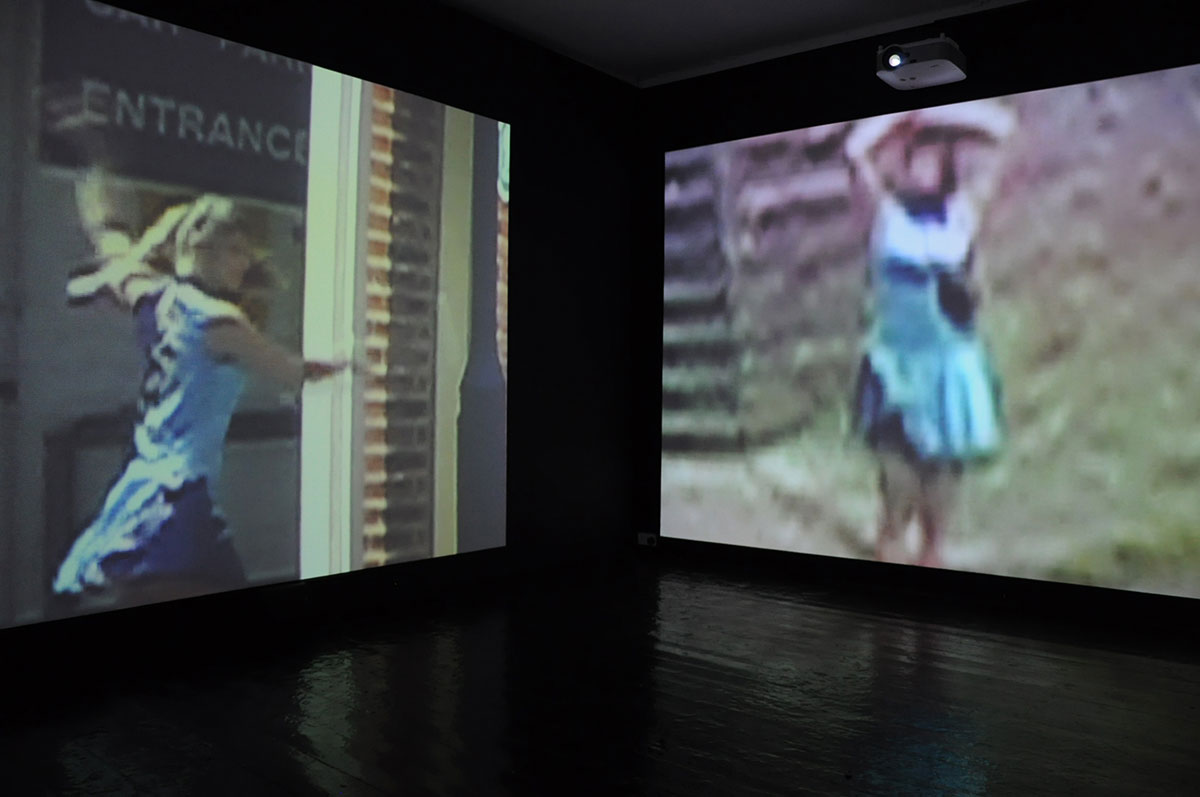
3 Channel sound/video installation on loop, 2010.
Produced as part of the Random Acts of Art residency at Exeter’s Spacex Gallery, which invited three artists to respond to the context of Exeter’s West Quarter and to involve residents in the production of an artwork.
Filmed from a distance and displayed across three walls in a pulse of long receding zooms, the work frames the routines of a majorette on multiple sites across Exeter’s Westquarter. Soundtrack is a multi-channel sound recording of the performer, their body and immediate environment.
The work perpetually reconfigures image and sound, creating a Verfremdungseffekt that distorts the boundaries between what appears to be a ceremonial and public display in one moment and the private actions of an individual the other.
Interview with Devon Artsculture
BBC Devon
Download Street Performance and Public Ritual, by Phil Smith
Extract from the residency journal
The dictionary defines a Quarter as a distinct neighbourhood – through aesthetics, demographics, types of use. I do not see the West Quarter as a distinct neighbourhood in terms of this definition. Within its historical borders the West Quarter is fragmented in architecture and use and if anything, distinctly lacking distinctiveness. Local history suggests that up to its clearance in the 1930s it was a quarter in the above definition of the term, albeit considered a slum of questionable reputation.
It is this historical West Quarter and its remnants that seems to grasp public imagination a lot more than the contemporary one – little surprise in a city that very much defines and brands itself through its history.
Its topography, the South facing slope between the city centre and the quay with a shallow valley around Coombe Street is particular. Built on South, West and East facing slopes overlooking the valley, there is little repetition in its roof and street-scape; scenarios vary. Whilst pedestrian traffic and outlooks from street level are somewhat channeled some of the views from residents’ windows must be quite spectacular.
Potentially the quarter could connect the town centre and the river which are Exeter’s two main tourist attractions. Arguably and for various more or less obvious reasons it doesn’t fulfill that role. Heavy motor traffic and outwards pointing retail miles define the West Quarters borders. The buildings along South Street present shop windows to the front and a rough industrial utilitarian design to the back. This unattractive backstage scenario is the first experience for everyone penetrating the shopfronts through one of the hidden passage ways from a city centre direction. The architecture between Market Street and South Street might be a relic of car centred after war town planning but it also strongly suggests that the West Quarter was not considered to be a relevant part of a city centre experience. No efforts were made to open up the West Quarter since.
The architectural eclecticism within the quarter does not contribute to an overall picture. Many of its sections are hermetic and self contained. Its Eastern tip between City Wall and Coombe Street is sealed off from the Western parts and internally further divided in two junks by unsurmountable fencing. The 1980s housing estate east of Rack Street is tucked away in a dead end. Irrelevant as a transit route it is virtually non existent to the general public, and therefore it does not strive to contribute to a West Quarter experience. Like a village within the city it trades a limited privacy for the potential benefits of open and functioning inner city public space.Similarly unique is the enormous building along Coombe Street, featuring retail at the bottom and a block of 28 anonymous flats on top. To some residents this complex goes by the name of little Beirut.Most people when speaking of the West Quarter imagine the area between Market Street, Preston Street, West Street and Fore Street which is roughly one third of the overall size of the quarter. These are also the parts with most of the historic housing, the communal heart of which I suspect in the café above Stepcote Hill and the Fat Pig pub respectively. It is the absence of a town planning concept that recognizes the West Quarter’s historic boundaries, its fragmentation and the absence of public space that would be my starting points for the residency.